NEWS & EVENTS
Follow the latest developments
from the IncluDE Project.
Discover project milestones, workshops, publications, collaborative activities and events
supporting inclusion, diversity and equity in higher education.
IncluDE on Spanish National Radio!
How can higher education become more inclusive, equitable and accessible for every learner?
Representatives from UNED, the European Students' Union, Universidade Aberta, and EADTU joined Sin Distancias on Radio 3 (RTVE) to discuss the challenges and opportunities of building more inclusive higher education across Europe.
Now available to listen back, the interview explores how the IncluDE project is working towards a European Inclusion Reference Framework and a set of practical tools to help higher education institutions assess, strengthen and embed inclusion, diversity and equity in their policies and practices.
🎧 Listen from 21:30 onwards:
📻 https://www.rtve.es/play/audios/uned-radio-3/uned-sin-distancias-26-06-26/17130807/
▶️ Or on YouTube: https://www.youtube.com/watch?v=Wlx8SMYr5_w
IncluDE showcased at ECYS 2026 and beyond
The IncluDE project continues to strengthen its European outreach by presenting its work at key events and engaging with a growing network of higher education professionals, researchers, and stakeholders.
Most recently, the project was featured at the ECYS Research Knowledge Exchange Event, where it was introduced to an audience of more than 50 participants. IncluDE was also presented as a strategic initiative during The Open University's WELS Faculty Assembly, reaching over 60 attendees on site and more than 685 colleagues online. The strong interest generated during both events was reflected in the high demand for project information and dissemination materials.
The project's visibility will continue to grow in the coming months through its inclusion in the forthcoming ECYS Newsletter, which reaches an audience of more than 3,000 readers. Together, these dissemination activities help raise awareness of the project's goals and foster collaboration around advancing inclusion, diversity, and equity across European higher education.
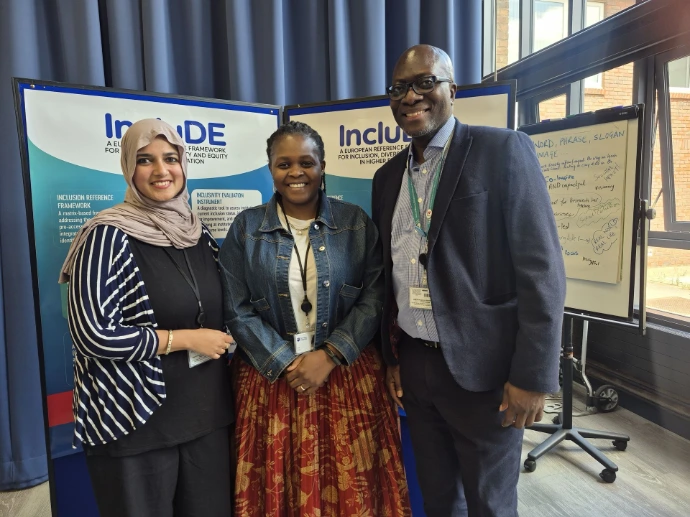 Farnaz Rais, Dr Jane Doka, and Prof Eric Addae-Kyeremeh, the IncluDE team at The Open University (UK)
IncluDE advances European Reference Framework for Inclusive Higher Education
The IncluDE project has reached another important milestone in the development of its European Inclusion Reference Framework. At the heart of this work is a prototype Inclusion Maturity Model, designed to help higher education institutions assess and strengthen their approaches to inclusion, diversity, and equity.
The model supports institutions in reflecting on their policies and practices across the entire student journey, enabling both practitioners and institutional leaders to identify areas for improvement and plan targeted actions. By combining self-assessment with a structured maturity approach, the framework aims to support continuous institutional development towards more inclusive learning environments.
A first version of the model was introduced during the IncluDE workshop at EADTU's 2026 Staff Support Event in June. The session generated valuable discussions, with participants recognising the framework's practical relevance and its potential to help higher education institutions embed inclusion more systematically. The feedback collected during the workshop will now inform the next iteration of the framework as the project continues its development.
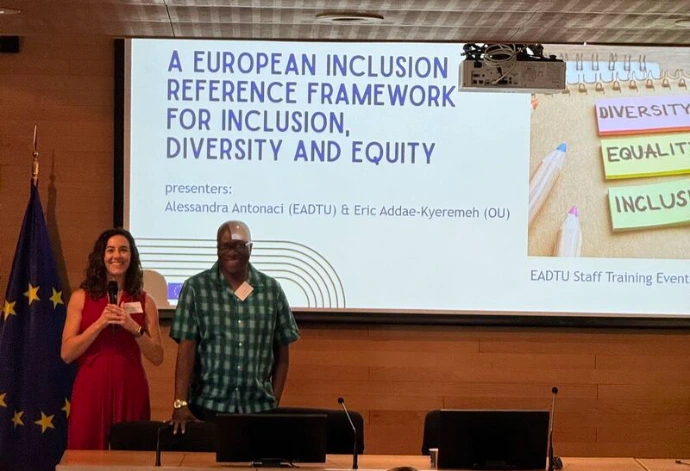 Dr Alessandra Antonaci (EADTU) and Prof Eric Addae-Kyeremeh (OUUK) at EADTU's Staff Support Event 2026
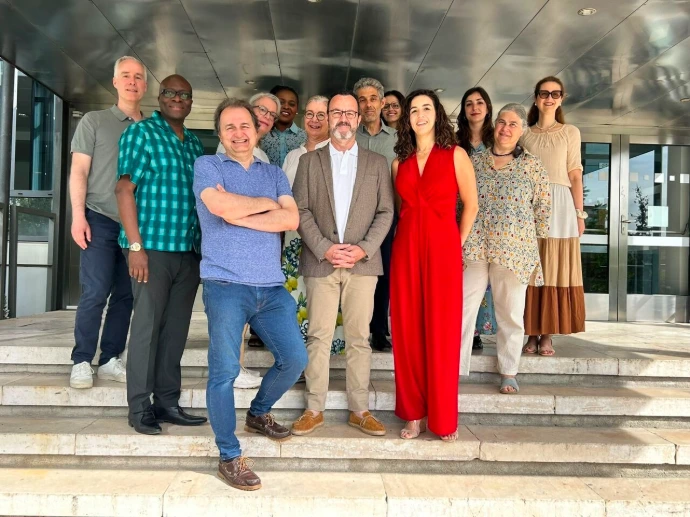 The IncluDE consortium with Mario Peña, Dean of the Faculty of Education at UNED (centre).
IncluDE Partners meet in Madrid to shape the next phase of the project
On 2–3 June 2026, the IncluDE consortium gathered at the Faculty of Education of the National University of Distance Education (UNED) in Madrid for its latest project meeting. The two-day event brought partners together to review progress, exchange expertise, and define the priorities for the next stage of the project.
OUUK to lead key work on Inclusion Indicators
in the IncluDE Project
Towards the end of 2025, the Open University (UK) colleagues in the IncluDE project (including Professor Eric Addae-Kyeremeh, Farnaz Rais and Jane Doka) focussed on the development of indicators for the Inclusion Reference Framework.
The indicators will form the basis of a future assessment tool designed to support Higher Education Institutions (HEIs) across Europe in reflecting on, evaluating, and strengthening their institutional approaches to inclusion. This represents an ambitious yet timely step for the project, with the potential to generate practical, evidence-based support for inclusive transformation in European higher education.
IncluDE has developed a compendium of key principles and recommendations on inclusion, equity, and diversity in higher education and lifelong learning.
The compendium provides both guiding principles — to shape policies, strategies, and pedagogies that promote inclusivity — and practical recommendations — actionable proposals for improving current practices. Together, these will form the basis for developing indicators for the forthcoming Inclusion Reference Framework.
To achieve this, the publication has:
- Mapped research and innovation literature through a rapid evidence assessment on inclusion, equity, and diversity.
- Reviewed EU policies and initiatives in these areas.
- Analysed national and institutional guidelines and frameworks for inclusion in higher education.
- Identified and validate key principles and recommendations through stakeholder engagement.
EU Diversity Month 2025 Highlights Mental Health and Wellbeing in the Workplace
Throughout May 2025, the European Union celebrated EU Diversity Month, placing a strong spotlight on the theme "Promoting Mental Health and Wellbeing at the Workplace." The month-long initiative, running from May 1 to May 31, aimed to foster inclusive, supportive, and healthy work environments across the EU.
EU Diversity Month is designed to raise awareness about the importance of diversity and inclusion in the workplace and in society at large. It emphasizes the representation and visibility of different groups, encouraging organisations to value diverse perspectives and integrate them into their work culture.
This year’s focus on mental health underscored the European Commission’s commitment to combating discrimination while creating environments that safeguard employees’ wellbeing. Organisations across Europe were invited to host events, workshops, and campaigns highlighting their efforts, using the hashtag #EUDiversityMonth to share their initiatives publicly.
By promoting mental health and inclusion together, EU Diversity Month 2025 reaffirmed that a truly diverse workplace is one where everyone feels supported, valued, and empowered to thrive.
Click here to read more.

IncluDE Project officially kicked off!
On Thursday 23 of January 2025, EADTU kicked off the IncluDE project, seeking to build a European Reference Framework for Inclusion, Diversity and Equity in Higher Education.
All fourteen partners from twelve countries were present and are dedicated to creating a fairer, more inclusive higher education system for everyone. The project focuses on developing an Inclusion Reference Framework that higher education institutions can use to assess their practices, identify gaps, and plan for improvements to support educators, administrators, and students in building inclusive learning environments.
We look forward to working together!
Introducing IncluDE: Advancing Inclusion in European Higher Education
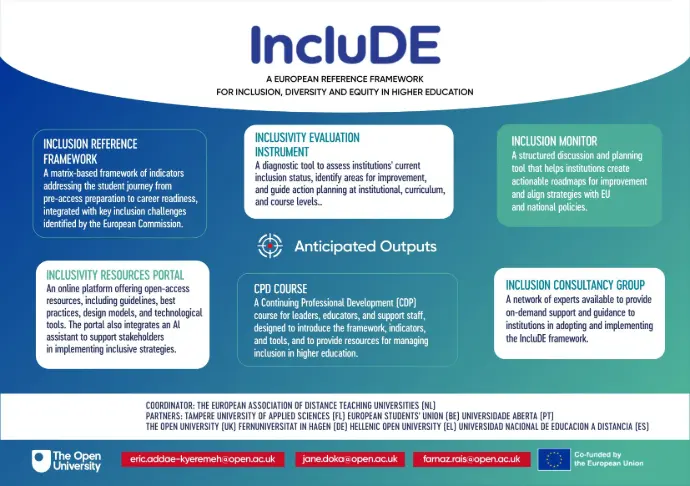
IncluDE is a three-year Erasmus+ project supporting higher education institutions in making inclusion, diversity and equity part of everyday practice. Running from January 2025 to December 2027 and coordinated by EADTU, the project will focus on the full student journey, from access and admission to learning, assessment, progression and preparation for future careers.
At the heart of IncluDE is the development of a European Inclusion Reference Framework, supported by an evaluation instrument, an Inclusion Monitor, a resources portal and a professional development course. These tools will help institutions assess current practices, identify barriers and plan realistic improvements.
The consortium will bring together eight full partners and six associated partners from across Europe, combining expertise in open and distance education, student representation, inclusive learning and institutional change.